
Research
Algebra of State Tracking
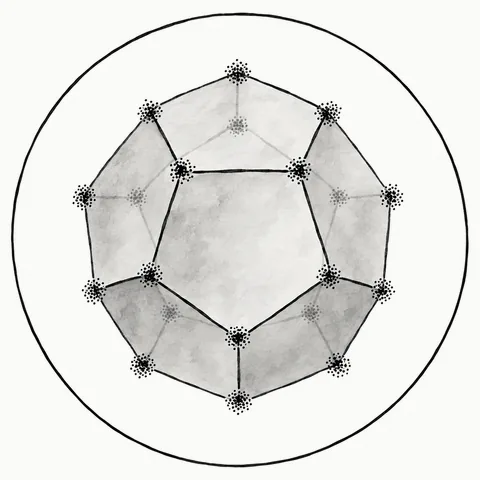
How does a neural network keep track of a changing state? We train networks to follow a running product of group elements and read what they learn through group theory. A partly correct Transformer often knows exactly which class the answer lies in and guesses evenly within it, so one over the class size predicts its accuracy. The Transformers we surveyed only settle on cosets of normal subgroups, while recurrent networks also pass through non-normal ones; for A₅, their hidden states arrange coset means into approximate dodecahedra.
Z. Zhang and Y. Li, "Tracking States or Tracking Cosets? An Algebraic Account of Learned State Tracking," arXiv:2609.29951 (2026)

AI 4 Science
Artificial intelligence is revolutionizing science. Neural networks, by ingenious design, can fit complex functions such as the distribution of molecular conformations. In science we encounter many of these functions that humans cannot analytically derive. AI, by learning from substantial data, helps us fit these functions and reveals what is essential.
Z. Zhang et al., "Generating knotted polymer and protein structures by machine learning," Communications Chemistry 9, 283 (2026)
Active Matter Simulation and Theory
Active matter consists of individual dynamic objects that move by dissipating inherent energy or energy from the environment — think a flock of birds swarming across the sky. When these individuals move collectively they exhibit fascinating patterns called Motility Induced Phase Separations (MIPS). I use physical and mathematical models to simulate active matter systems and gain insights into the interactions, symmetries, and thermodynamic properties behind them.
Z. Zhang et al., "Behavior of Active Polymer Knots," Macromolecules 58, 11229–11236 (2025)
Experiments on Bacteria
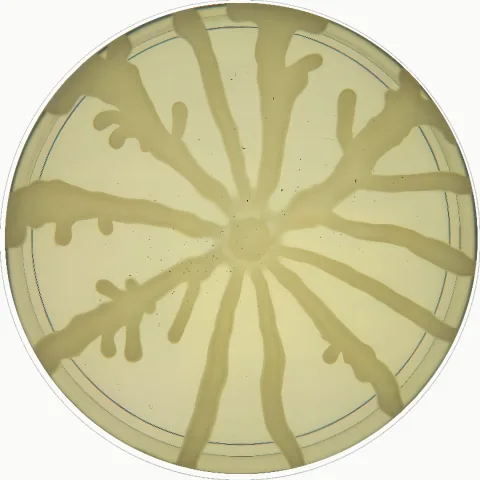
Bacteria are one of the most accessible active matter systems in the world. They play important roles from health to food production. Testing dynamic properties of bacteria in the lab is a key way to understand them and gain insights into general laws that extend to other active matter systems.
Z. Zhang et al., "Enterobacter sp. strain SM1_HS2B manifests transient elongation and swimming motility in liquid medium," Microbiology Spectrum 10 (2022)